Not many people know this but I don't like chicken rice and bak ku teh (I was told that I am the oat unpatriotic person :/), Indian food is really one of my least favourite cuisines. Other than my once yearly butter chicken / murtabak / roti prata craving, I don't really eat Indian food. I find the curries and spices overly aromatic and I don't particularly like the oily feeling I get after eating.
Since I learnt my lesson in Bhutan, I armed myself with lots and lots of snacks (Hello Panda, Pocky, potato chips and Tao Kae Noi) and a whole load of instant noodles, before I went to Indian, just in case my hotels didn't have international food. Kiasu max.
Fortunately, I didn't have to eat any of them (save for 2 days where I didn't want to eat the Indian food at the hotel restaurant but I wasn't hungry enough for instant noodles).
This was one of the first meals we had in Darjeeling - I think it was Tibetian food and not Indian food. Lots of curries, pickled vegetables with rice. The brown soup at the front left hand corner is lentil soup, not really my cup of tea.
One of the many roadside stalls selling food - I don't know what this is called, but it's a potato mixture with what looks like dried fried noodles on top.
Check out the environmentally friendly leaf cup!
A street vendor selling Pani puri
There's a puffed cracker which he first makes a hole in, stuffs a potato spice mixture into the cavity, and dips it into a jar of turmeric soup.
Hygiene standards are very questionable.
Whereby whoever is eating it will do so straight away, before the whole cracker becomes soggy.
You can
read more about Pani Puri here I didn't eat it cos of the questionable hygiene and I'm super paranoid about getting gastroenteritis (I didn't get GE in the end! And neither did my friend who spent the whole time eating the aforementioned street food with questionable hygiene standards)
One of the many biscuit shops along the way - lots and lots of biscuits.
Random Sweet Shop
Jalebi, which is a deep fried flour based crispy snack, which is saturated with rose syrup.
I'm not sure what this is called but its' a small pieces of deep fried potatoes with spices, similar to a vegetarian version of popcorn chicken. Highly addictive.
The famous rosso gula (white ball at the back), there's a similar version which is brown in colour and comes in rose syrup. It's so insanely sweet I feel like I'm going to get diabetes just by tasting it. The little coloured balls in front are some sweets.
One of my favourite foods - thukpa, which is similar to those ban mian kind of noodles you find at the food courts/hawker centres. I'm not sure if it's a Sikkimese dish or a Nepali dish (according to some online sources it's Nepali but it's widely available in Sikkim). Since I don't eat beef, I usually go for the vegetable thukpa as most of the restaurants are quite small and only stock one kind of meat.
We ate so much thukpa cos it's one of the few dishes that I really enjoyed! I was so thrilled to have found something that I really liked, so we had it for most lunches.
Beef Thukpa
Vegetable Thukpa
I think this was not thukpa but some kind of instant noodles, tasted the same to me anyway. I really love noodles compared to rice so any noodle dish is welcomed.
Something very similar to the Thukpa - but has a different noodle base - this one is a hand made shells which are very similar to macaroni. I think the flour base they use is same as the momo skin.
The momos, which are similar to the steamed Northern Chinese dumplings - very filling and usually stuffed with vegetables (cabbage, onion), cheese or minced meat (usually beef or chicken).
This was one of the hotel meals we had - usually fried rice with some stir fried meat (or curried meat) and stir fried vegetables.
One of the breakfast dishes we had, after dragging up everyone to watch sunrise at 4am. It's a potato curry, served with flatbread (looks like chapati but they call it roti).
Some snacks which we ate at a festival in a monastery.
Gundruk, a fermented vegetable soup which is usually eaten during winter. There's a mixture of mustard leaves, radishes, tomatoes etc inside the soup and it has a slightly sourish taste due to the fermentation process. It's quite similar taste as the szechuan sweet and sour soup we find in Singapore, just that it's not spicy.
I honestly don't know if this tomato and cheese soup is one of their local dishes, or something for westerners, but it was pretty good. I really like the fresh cheese (it's similar to ricotta) so just as long as there's cheese in anything I think it'll taste good.
Stir fried fresh organic mushrooms. Super delicious - I don't know what kind of spices they put in but it's so good.
Stir fried pumpkin (if you remember, it's the pumpkin we bought from the village earlier).
The tasty pumpkin
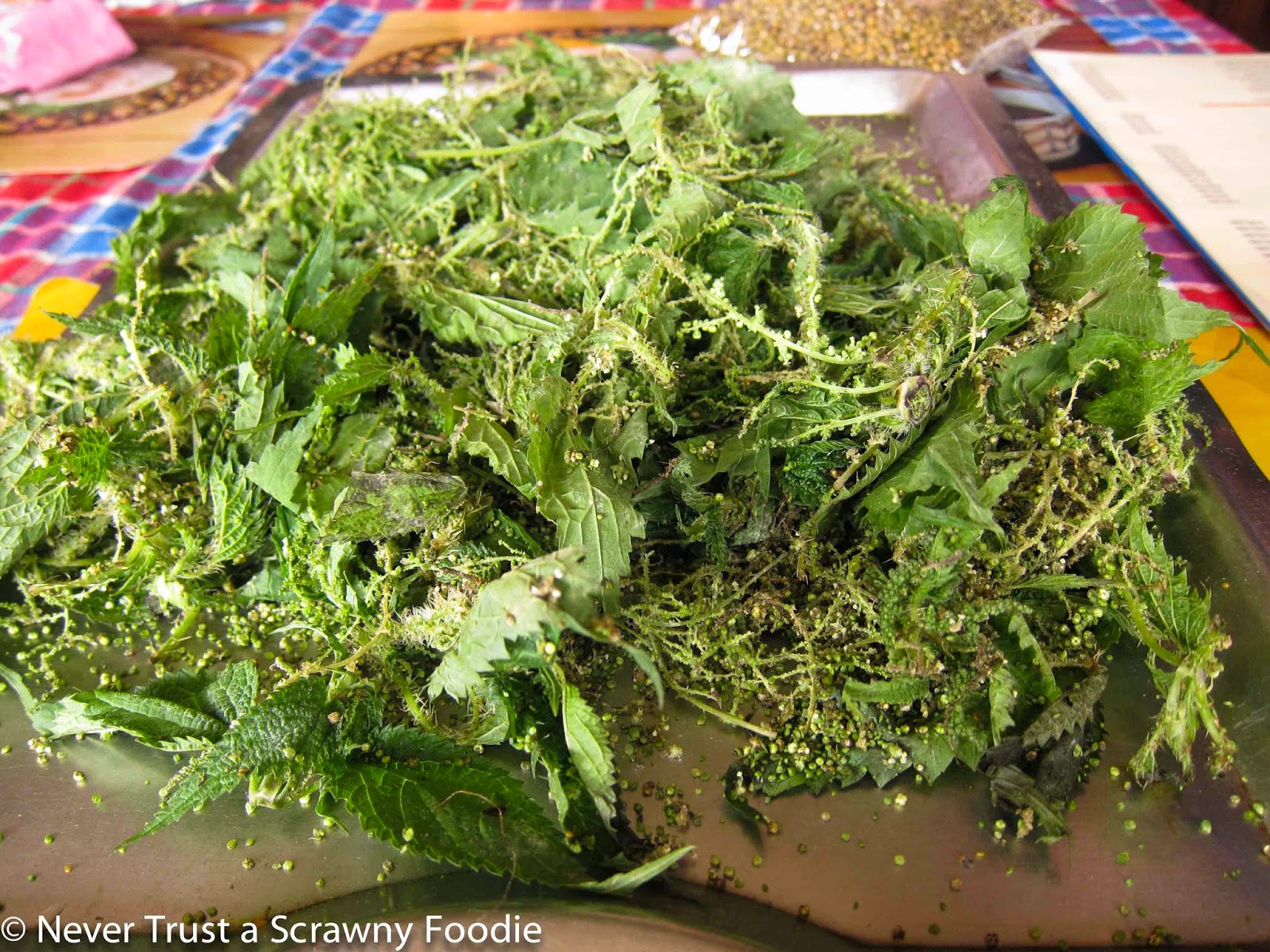
These are some wild jungle vegetables which is used to make shishnu
These were some fresh millet seeds which we saw in a farm, along the way.
And this is the local alcohol, called tongba or chang (see the
wiki page here). It's fermented millet seeds. Traditionally, it comes in a large bamboo cup (don't know where my bamboo cup photos went, but this one is a aluminium cup).
Drinking tongba takes a lot of time, and needs lots of patience. Hot water from a flask is poured into the bamboo cup, and the mixture is allowed to rest for about 5minutes, no stirring allowed (apparently you will get a bad headache if you stir the mixture - I think it's just the hangover). After waiting 5 minutes, you then drink the mildly sweet alcoholic mixture through the very eco friendly bamboo straw. The process is then repeated multiple times, until there is no more taste.
There's a shortcut way to drink tongba, which is to grind and squeeze the fermented millet seeds, and then sieve it through a cheesecloth. The resulting mixture is a white milky mixture which has a stronger taste. For people who are pressed for time I suppose.
This is the last post for my Darjeeling and Sikkim trip. I will do a short post on my transit in Kolkata soon. I really enjoyed my trip and am missing the times that we woke up super early (partly due to jet lag) to watch the sunrise and walking around admiring the scenery and breathing in the super fresh air. Sikkim isn't very commercialised or touristy yet, and amazing beautiful scenery. I will probably go back to visit the northern part which wasn't covered during this trip due to time constraints, and am planning a trip to Nepal next year (cannot wait! Hope my leave gets approved)
You can read more about my trip here.
Part 1
Part 2
Part 3
Part 4